
Civil resistance.
Nonviolent action.
Peacebuilding.
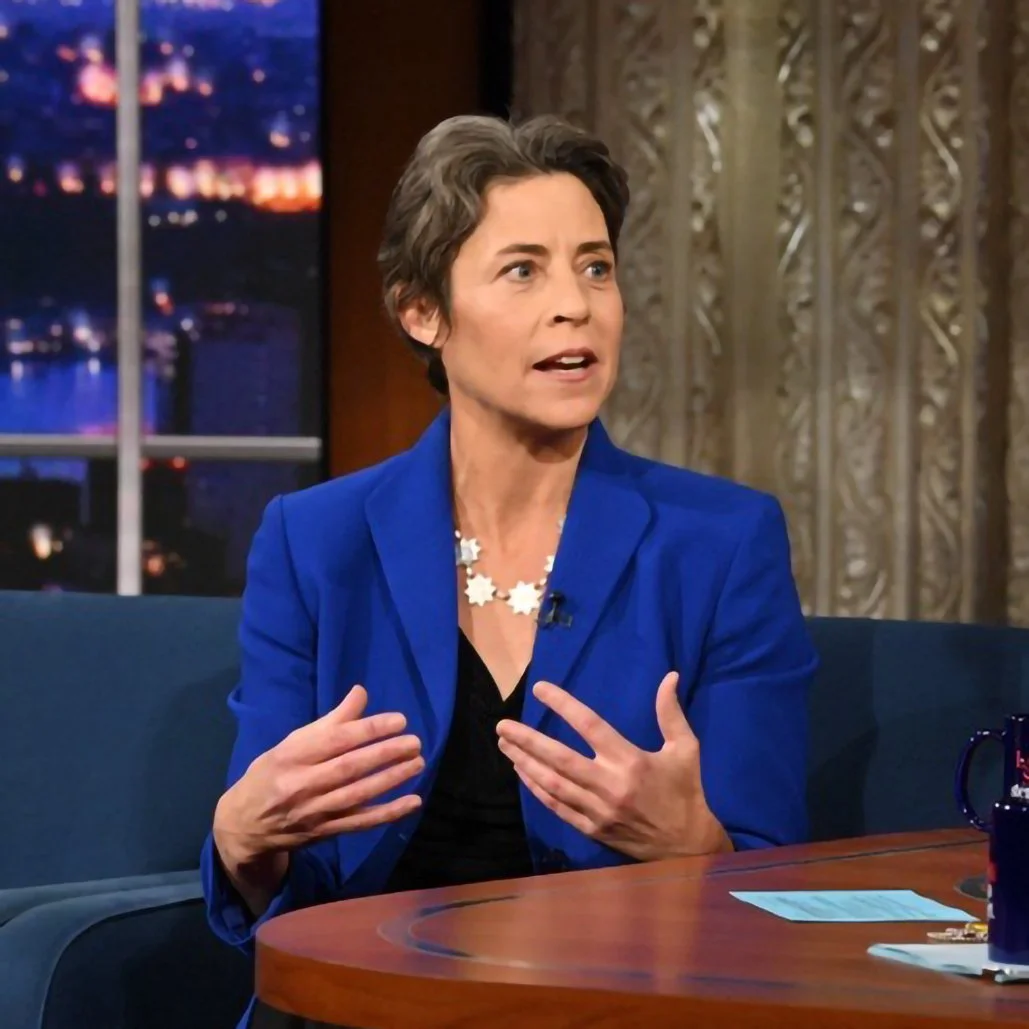
Image courtesy Scott Kowalchyk Photography and The Late Show with Stephen Colbert
About Dr. Maria J. Stephan
Dr. Maria J. Stephan is the Co-lead & Chief Organizer at the Horizons Project, an initiative focused on strengthening connections and collective action among US pro-democracy movements and sectors. Maria is an award-winning author and organizer whose work has focused on the role of nonviolent movements advancing human rights, democracy, and peace. She co-wrote (with Erica Chenoweth) Why Civil Resistance Works: The Strategic Logic of Nonviolent Conflict, which received the American Political Science Association’s award for the best book published in political science in 2012, and the Grawemeyer Award for Ideas Improving World Order.
Her other books include: The Role of External Support in Nonviolent Campaigns: Poisoned Chalice or Holy Grail?; Bolstering Democracy: Lessons Learned and the Path Forward; Is Authoritarianism Staging a Comeback?; and Civilian Jihad: Nonviolent Struggle, Democratization and Governance in the Middle East. Stephan’s work has been featured in the New York Times, The Washington Post, NPR, Foreign Affairs, Just Security, Foreign Policy, and Waging Nonviolence, among other outlets.
Before joining the Horizons Project, Stephan founded and directed the Program on Nonviolent Action at the U.S. Institute of Peace, overseeing applied research, a global training program, and work with policymakers to support activists, peacebuilders, and social movements in their struggles to advance more just, peaceful, and democratic societies around the world.
Earlier, Stephan was lead foreign affairs officer in the U.S. State Department’s Bureau of Conflict and Stabilization Operations, receiving two Meritorious Service Awards for her work in Afghanistan and with Syrian activists in Turkey. She later co-directed the Future of Authoritarianism initiative at the Atlantic Council, which informed activists and practitioners about global democracy trends and strategies for confronting authoritarianism. Stephan directed policy and educational initiatives at the International Center on Nonviolent Conflict, supporting dissidents and movements globally. She has taught graduate and undergraduate courses on civil resistance and human rights at Georgetown University’s School of Foreign Service and American University’s School of International Service.
Stephan received her BA in political science from Boston College and her MA and PhD from the Fletcher School of Law and Diplomacy at Tufts University. She received a Harry S. Truman national scholarship for public service and was a Fulbright scholar to Germany. Stephan is a lifetime member of the Council on Foreign Relations, an advisor to the Catholic Nonviolence Initiative, a trainer with the Freedom Trainers, and an active member of Showing Up for Racial Justice (SURJ). Maria is a proud Vermonter who resides in New York City.
Books
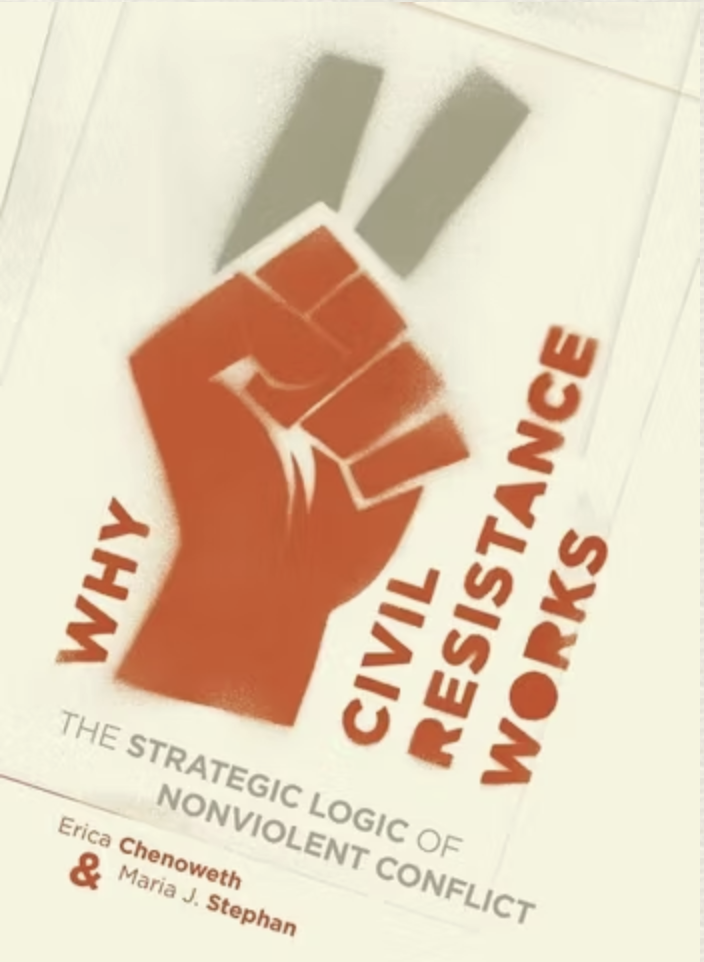
Why Civil Resistance Works: The Strategic Logic of Nonviolent Conflict
Erica Chenoweth and Maria J. Stephan
New York, NY: Columbia University Press, August 2011
“This is social science at its best. Years of critical study culminate in a book on one dominating issue: how does nonviolent opposition compare with violence in removing a regime or achieving secession? The authors study successes and failures and alternative diagnoses of success and failure, reaching a balanced judgment meriting careful study.” — Thomas C. Schelling, Harvard University, Recipient of the Nobel Prize in Economics
-
Winner of the 2013 Grawemeyer Award for Ideas Improving World Order
Winner of the 2012 American Political Science Association’s Woodrow Wilson Foundation Award given annually for the best book on government, politics, or international relations
A 2011 Book of the Year, The Guardian
Though it defies consensus, between 1900 and 2006, campaigns of nonviolent resistance were more than twice as effective as their violent counterparts. Attracting impressive support from citizens that helps separate regimes from their main sources of power, these campaigns have produced remarkable results, even in the contexts of Iran, the Palestinian Territories, the Philippines, and Burma.
Combining statistical analysis with case studies of these specific countries and territories, Erica Chenoweth and Maria J. Stephan detail the factors enabling such campaigns to succeed-and, at times, causing them to fail. They find that nonviolent resistance presents fewer obstacles to moral and physical involvement, information and education, and participator commitment. Higher levels of participation then contribute to enhanced resilience, a greater probability of tactical innovation, increased opportunity for civic disruption (and therefore less incentive for the regime to maintain the status quo), and shifts in loyalty among opponents’ erstwhile supporters, including members of the military establishment. They find successful nonviolent resistance movements usher in more durable and internally peaceful democracies, which are less likely to regress into civil war. Presenting a rich, evidentiary argument, this book originally and systematically compares violent and nonviolent outcomes in different historical periods and geographical contexts, debunking the myth that violence occurs because of structural and environmental factors and is necessary to achieve certain political goals. Instead, Chenoweth and Stephan find violent insurgency is rarely justifiable on strategic grounds.
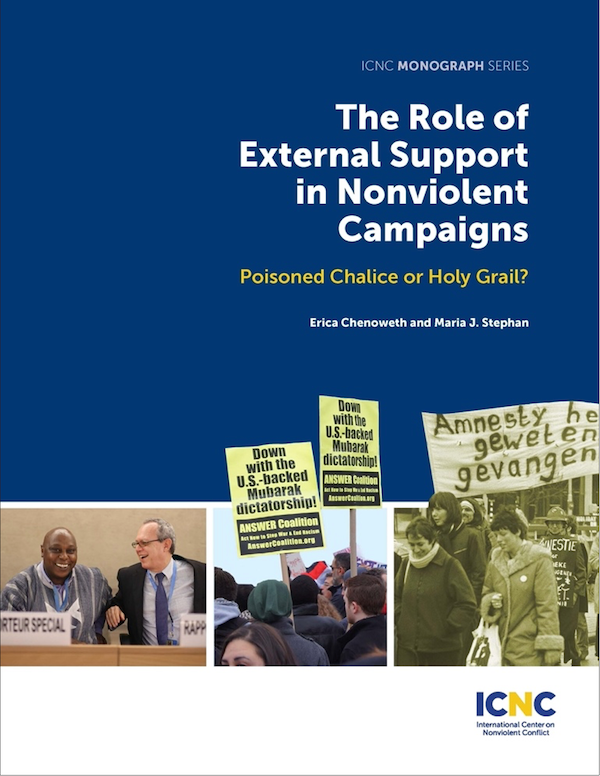
The Role of External Support in Nonviolent Campaigns: Poisoned Chalice or Holy Grail?
Erica Chenoweth and Maria J. Stephan
ICNC Monograph Series, 2021
-
This monograph is based on an ICNC-sponsored multi-year research project that examines the effects of different forms of external aid on the outcomes and longer-term impacts of civil resistance campaigns. Very little research has systematically investigated the impacts of external support on the effectiveness of nonviolent resistance. Existing research reaches somewhat contradictory conclusions, with some finding that external support for nonviolent campaigns is harmful, that external support is sometimes helpful, or that external support has little observable effect. This study assesses different types of external assistance—material and non-material—to civil resistance movements offered by state and non-state actors at different stages: pre-, during and post-conflict periods. It further evaluates the impact of the specific type of aid, its timing and provisions by different actors on the overall trajectories of civil resistance campaigns and their outcomes.
Burrows and Stephan have compiled this guide as a reminder of the absolute necessity of supporting democracy in the fight against authoritarianism and the potential erosion of a just way of life. Using case studies involving Cuba, the Philippines, Ethiopia, Kyrgyzstan, Ukraine, Azerbaijan, Zimbabwe, Pakistan, and Indonesia, they illustrate the challenges that support for democracy faces and explore
the importance of knowing when outside actors should back off,
the need for effective collaboration,
the best ways to effect a nonviolent transition in government,
the role of the private sector in supporting democracy, and
important insights about the long and complicated process of instituting and cultivating democracy.
These case studies demonstrate the truth about how fragile young democracies are-and the difficulties of outside support for them.
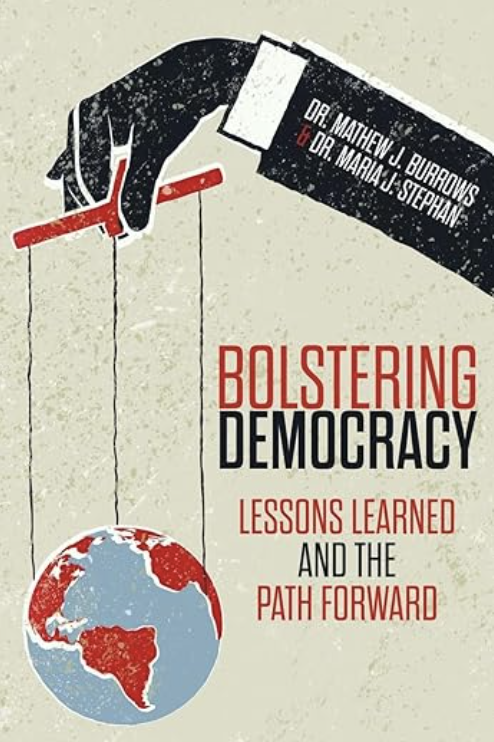
Bolstering Democracy: Lessons Learned and the Path Forward
Maria J. Stephan and Mathew J. Burrows
Createspace Independent Publishing, 2018
-
The rise of the Trump administration has changed the face of US politics forever. For authors Dr. Mathew J. Burrows and Dr. Maria J. Stephan, this seems to herald the backing away from supporting democracy. When America's president seems indifferent about protecting the institutions of democracy, citizens may feel disinclined to remember the lessons history has taught us.
Burrows and Stephan have compiled this guide as a reminder of the absolute necessity of supporting democracy in the fight against authoritarianism and the potential erosion of a just way of life. Using case studies involving Cuba, the Philippines, Ethiopia, Kyrgyzstan, Ukraine, Azerbaijan, Zimbabwe, Pakistan, and Indonesia, they illustrate the challenges that support for democracy faces and explore
the importance of knowing when outside actors should back off,
the need for effective collaboration,
the best ways to effect a nonviolent transition in government,
the role of the private sector in supporting democracy, and
important insights about the long and complicated process of instituting and cultivating democracy.
These case studies demonstrate the truth about how fragile young democracies are-and the difficulties of outside support for them.
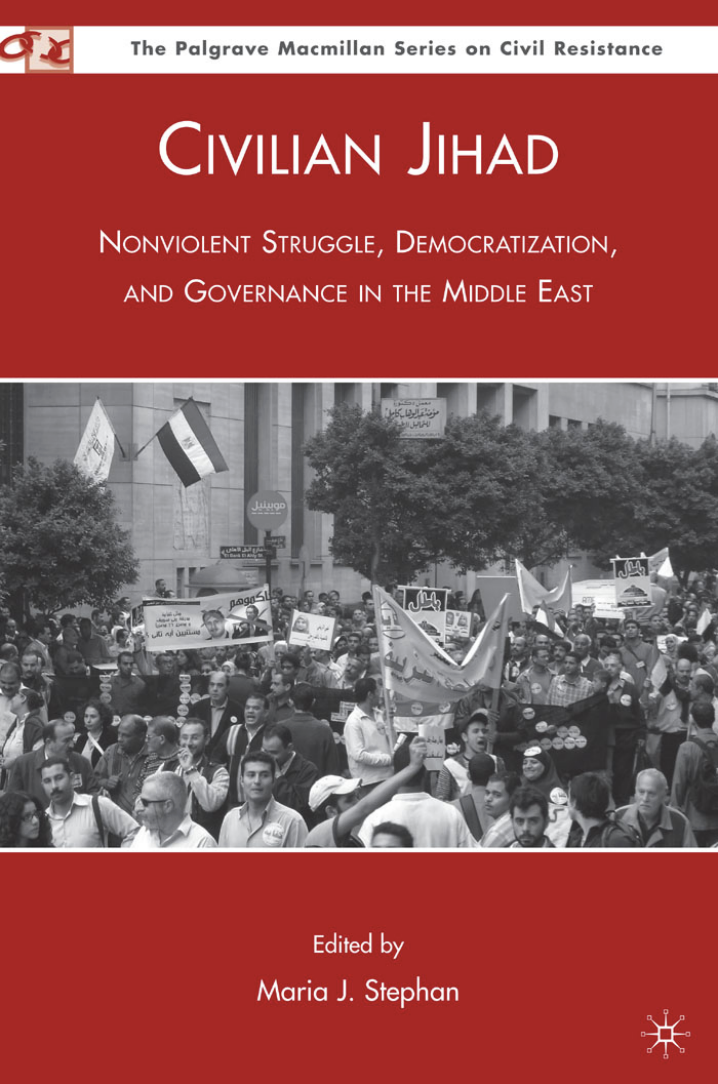
Civilian Jihad: Nonviolent Struggle, Democratization, and Governance in the Middle East
Edited by Maria J. Stephan
The Palgrave Macmillan Series on Civil Resistance, December 2009
-
The Middle East, a region infamous for political violence and a democratic deficit, boasts a rich but little-known history of nonviolent civilian-led struggles for rights and freedoms. Ordinary Egyptians, Palestinians, Turks, Israelis, Iranians, Kuwaitis and other Middle Easterners have, over the past century, used nonviolent “weapons,” including boycotts, strikes, demonstrations, sit-ins, and other methods of civil disobedience and noncooperation, to courageously challenge entrenched power and to advance democratic self-rule. This book challenges the oft-heard claim that nonviolent resistance “can’t work” in the Middle East by chronicling some of the most significant nonviolent campaigns against colonialism, foreign occupation, authoritarianism, and structural injustice in the region. Other chapters examine the role of strategy, political humor, religion, Islamist movements, and external actors in advancing and impeding democratization and good governance. This volume, which includes scholarly and activist perspectives, will be of particular interest to academics, policymakers, journalists, and local civic leaders interested in the Middle East, nonviolent action, social movements, democratization, and war and peace studies – as well as educated general readers interested in understanding present convulsions in the Middle East.
Articles

Big Tents and Collective Action Can Defeat Authoritarianism
Lessons from Around the World: Engaging ‘Pillars of Support’ to Uphold and Expand Democracy
When Loyalties Shift: Americans’ Growing Noncooperation with Federal Abuses of Power
The Global Far-Right Authoritarian Alliance Threatening US Democracy – And How to Weaken It
For US Independence Day, January 6th Hearings Reveal Authoritarianism’s Achilles Heel
Combatting Authoritarianism: The Skills and Infrastructure Needed to Organize Across Difference
How Domestic Civic Movements Could Reshape US Foreign Policy
Nonviolent Civic Action May Help Defend the Integrity of the Election


America Magazine
Political Violence at a Glance
The Guardian
The Washington Post
Salon
Podcasts & Interviews
How Blowing A Whistle Is An Act Of Nonviolent Resistance - Maria J. Stephan
Nonviolent resistance scholar Maria J. Stephan joins the Late Show with Stephen Colbert and talks about things regular citizens can do to push back against government aggression without the threat or use of violence. Watch on CBS.
“They Have Agency In This Moment. They Can Walk Away.” - Maria J. Stephan’s Message To ICE Officers
Author and nonviolent resistance scholar Maria J. Stephan points out that state violence frequently backfires, and offers an off-ramp to those who have signed up to work for ICE. Watch on CBS.
Resources
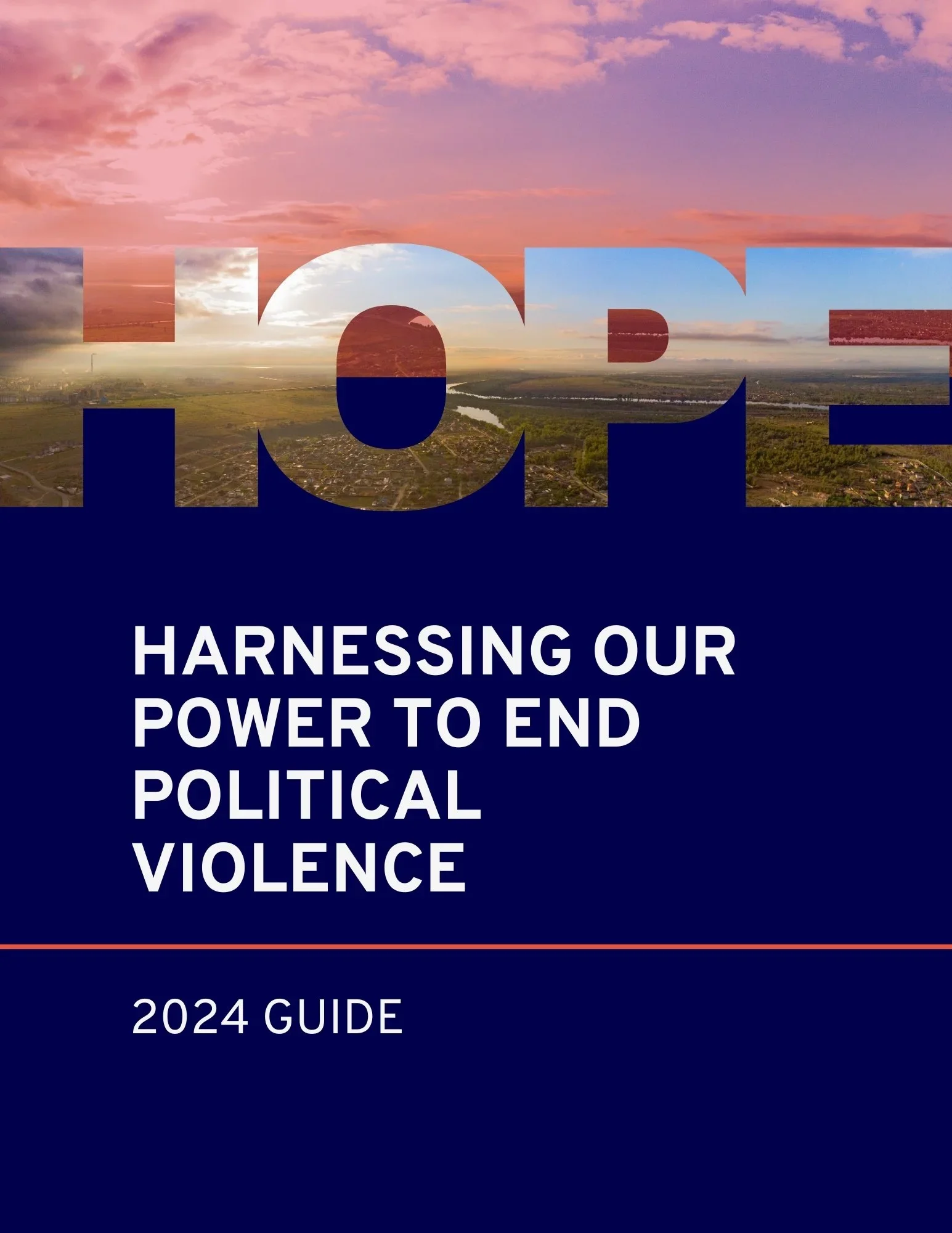
The HOPE guide is designed to help people across the United States counter political violence. It aims to empower individuals and strengthen communities to make political violence backfire against those who incite, threaten, and enact it.

Around the world, training pro-democracy activists is a core strategy of successful movements—and one of the few true “no-regrets” actions for strengthening civil society’s capacity for nonviolent resistance.